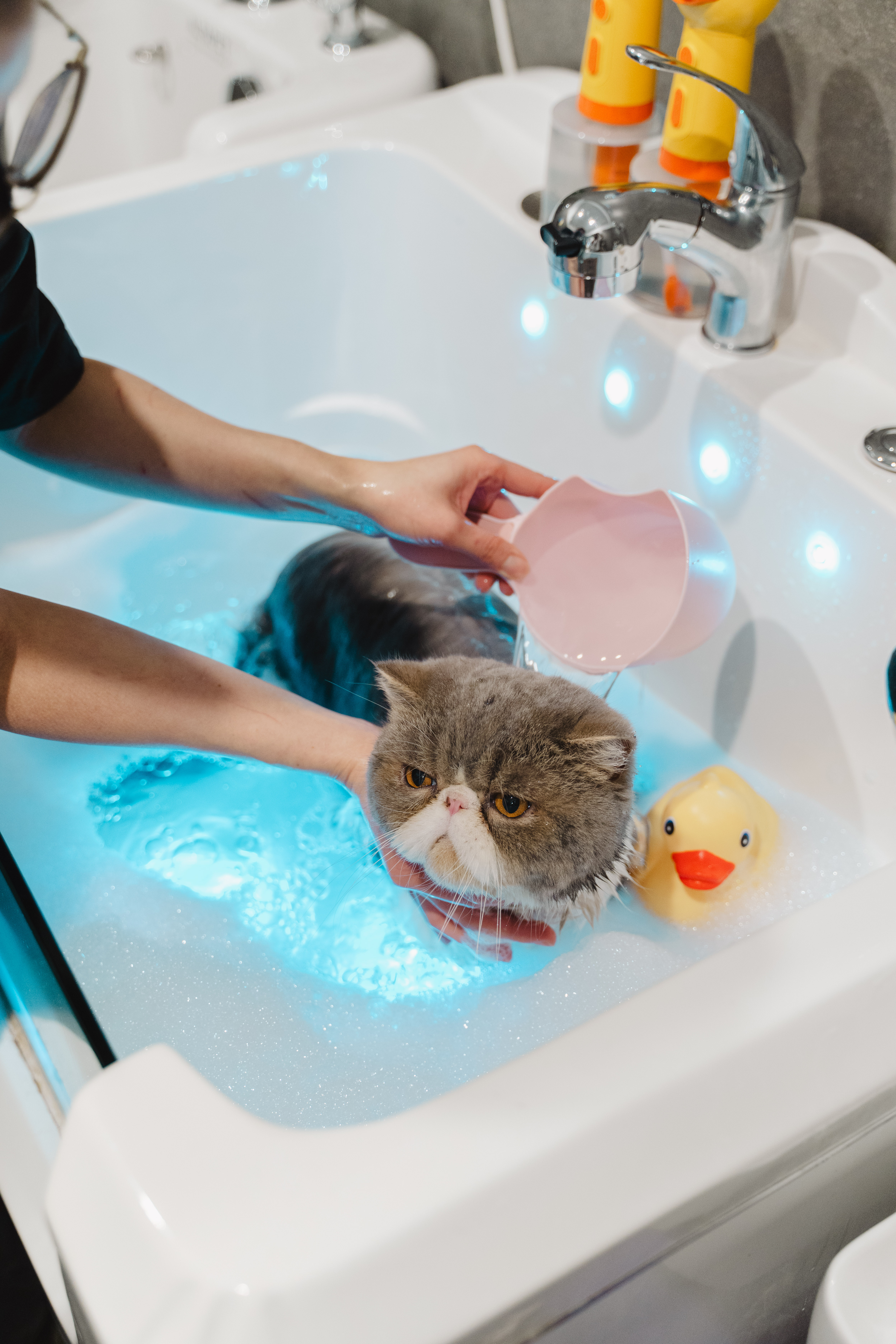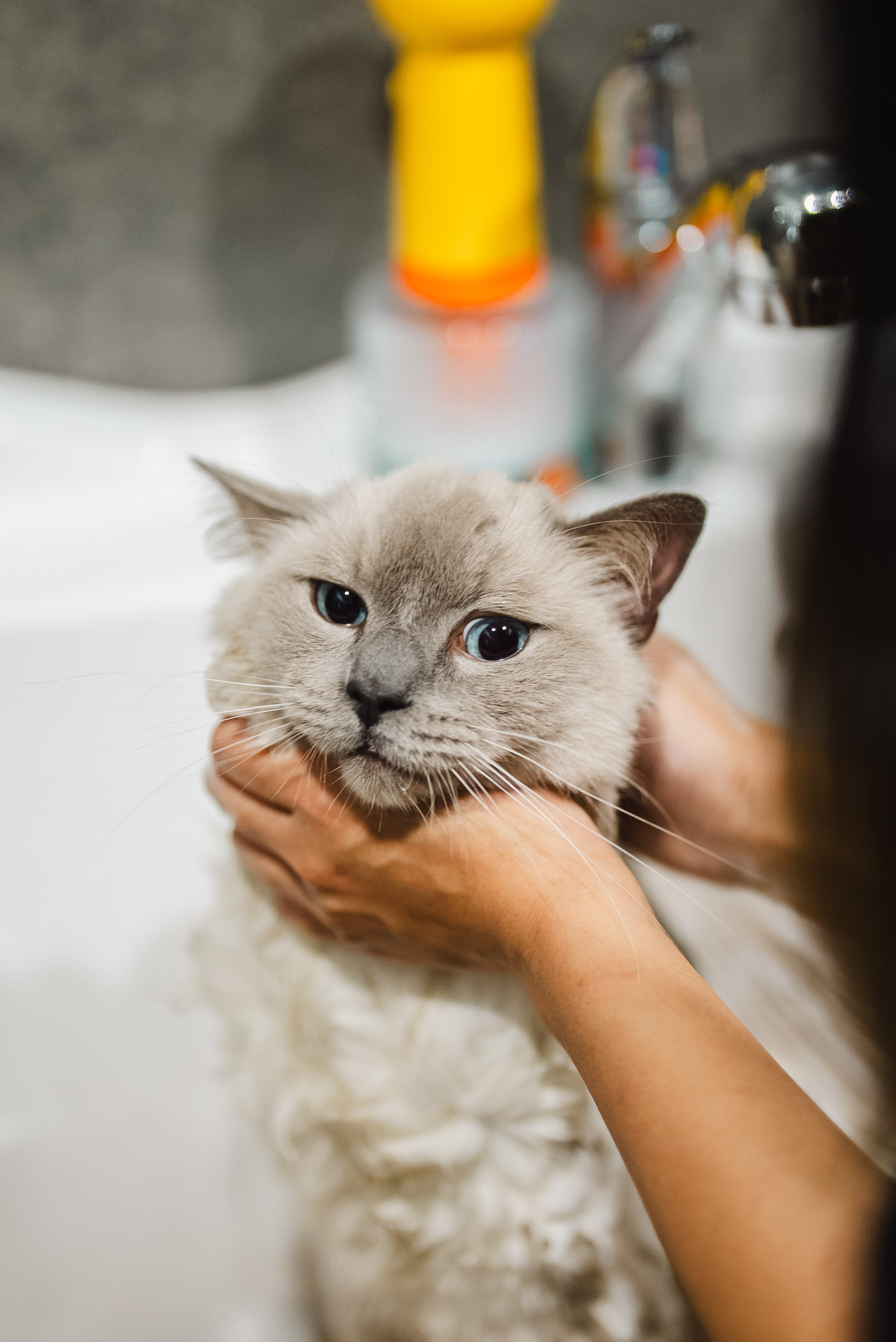
01 — What We See Too Often
By the time some cats reach us, the coat has already lost the argument.
We don't say this to shame anyone — most owners genuinely don't know how fast a small problem turns into an urgent one. But there's a pattern we see constantly, and it always starts the same way: grooming was treated as something to sort out eventually, not something to schedule.
- Matting gone from "a few tangles" to pelted patches pulling on the skin, sometimes needing a full shave under sedation to remove safely.
- Sanitary trims left so long that faecal matter is stuck to the fur around the bottom — uncomfortable, unhygienic, and entirely preventable with a trim every few weeks.
- Shedding left to build for months, then owners hoping one deshedding wash will undo it all in a single visit.
None of these are one-appointment fixes. They're the result of grooming being reactive instead of routine.
02 — Why Timid Cats Need Predictable, Not Occasional
A scared cat's brain is asking one question: is this safe?
Cats are self-sufficient by nature — even living in our homes, they rely on themselves for protection, not us. That means feeling safe comes down to one thing above all: a familiar, predictable environment they feel some control over. Take predictability away, and a cat has no way to know whether a situation is a threat, so their nervous system defaults to protecting them — retreat, freeze, or fight.
A cat's emotions and experiences are real to that cat, and they shape their wellbeing — which is exactly why we can't treat a first-time or occasional groom as a neutral event. To the cat, it never is.
This is well established in feline welfare guidance: cats are sentient, individual animals whose emotional state — not just their physical health — determines their quality of life, and unpredictable or unfamiliar situations are a major trigger for fear and anxiety responses (Safe and Happy Cats, RSPCA Australia). A cat who only sees the salon once in a blue moon, at random intervals, never gets the chance to learn that it's safe. Every visit stays a first visit, emotionally.
03 — Routine Is the Actual Care
Booking around your convenience isn't the same as booking around your cat's needs.
It's tempting to book a groom whenever it suits your calendar — but a cat doesn't experience "whenever." They experience a pattern, or they experience chaos. A consistent schedule is what turns grooming from something that happens to a cat into something a cat learns to move through calmly.
That's the actual work of caring for a timid cat: not avoiding the salon because they're scared of it, but building enough familiarity — with us, with the room, with the process — that the fear has less to grip onto each time. That takes patience, and it takes showing up on a schedule, not just when the coat forces the issue.
04 — Routine, By Breed
"Every few months" means something different depending on the coat.
Coat type is the biggest factor in how often a groom actually needs to happen — a Domestic Short Hair and a Persian are not on the same clock. These are our general starting points; your groomer will always adjust for your individual cat's temperament and coat condition.
| Breed | Recommended service | Frequency |
|---|---|---|
| Domestic Short Hair | Deshedding wash & dry | Every 8–10 weeks |
| Domestic Medium / Long Hair | Deshedding wash & dry + sanitary trim | Every 6–8 weeks |
| British Shorthair | Deshedding wash & dry + sanitary trim | Every 6–8 weeks |
| Ragdoll | Belly tidy-up + deshedding wash & dry | Every 6–8 weeks |
| Maine Coon | Deshedding wash & dry + sanitary trim | Every 6–8 weeks |
| Persian | Teddy Bear Cut + wash | Every 10 weeks |
| Himalayan | Teddy Bear Cut + wash | Every 8–10 weeks |
| Scottish Fold (long-haired) | Deshedding wash & dry + sanitary trim | Every 6–8 weeks |
| Siamese / Oriental Shorthair | Deshedding wash & dry | Every 10–12 weeks |
| Sphynx (hairless) | Full body oil-removal wash | Every 1–2 weeks |
These are general guidelines — individual temperament and coat condition always come first.
THE SCHEDULE WE RECOMMEND
Long-haired or easily matting coats: professional groom every 6–8 weeks. This is also the realistic interval for deshedding to actually work — it's a maintenance rhythm, not a single miracle wash.
Sanitary trims: as needed between grooms if fur around the bottom is catching mess — waiting until it's a hygiene problem makes the appointment harder on everyone, including the cat.
Matting: the earlier we see it, the gentler the fix. Left too long, the only safe option left is often a full shave.
A predictable schedule doesn't just keep the coat in good shape. It's how a scared cat learns, one calm visit at a time, that going out doesn't only mean something bad is happening.
Feline emotional welfare information referenced from Safe and Happy Cats — RSPCA Australia.